Quincy Market vs. Faneuil Hall: What's The Difference
Quincy Market and Faneuil Hall sit on the same plaza but are two different buildings with two different jobs. Here is what each one actually is, and which one a food traveler wants.
Quincy Market vs. Faneuil Hall: What's The Difference
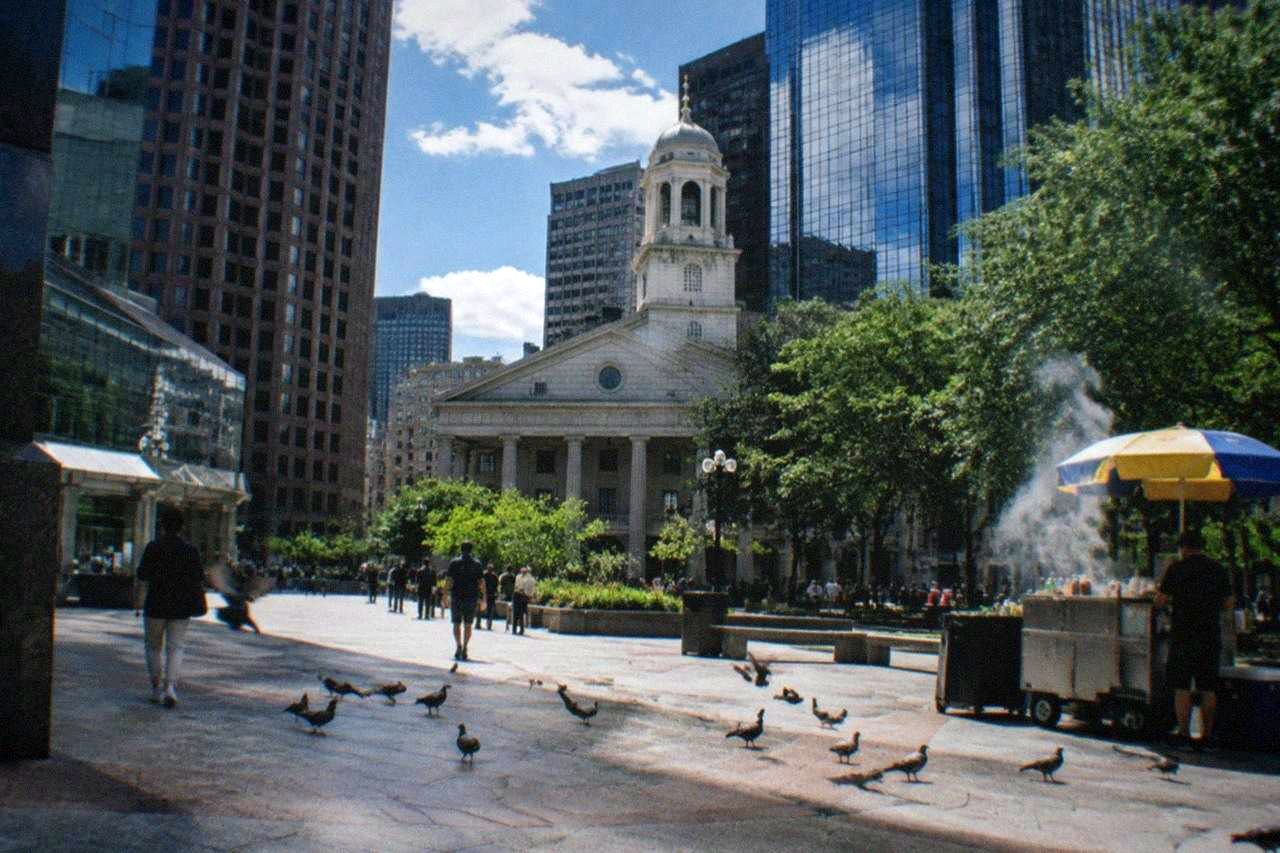
Faneuil Hall, built in 1742, is a public meeting hall with a marketplace on the ground floor; Quincy Market, built in 1826, is a long food hall designed to relieve overcrowding at that marketplace. Faneuil Hall is where Bostonians argued politics, and it is now part of Boston National Historical Park. Quincy Market is where you eat. The two buildings face each other across the same cobblestone plaza, and most visitors walk through both without noticing the seam.
The confusion is understandable. The whole complex, Faneuil Hall, Quincy Market, North Market and South Market, is often marketed as one destination called Faneuil Hall Marketplace, and locals do the same thing in conversation. Ask a Bostonian where to get chowder downtown and they will say "Faneuil Hall" even when they mean the food stalls inside Quincy Market, three buildings away. The names have merged in daily speech, even though the buildings never did.
The practical difference for a visitor is simple. Faneuil Hall is a free museum piece you walk through in twenty minutes: a National Historic Landmark, gifted to the town by merchant Peter Faneuil in 1742 as a marketplace and public meeting space, expanded in 1805-1806, and still hosting the kind of civic rhetoric that earned it the nickname "the Cradle of Liberty." Quincy Market is the food hall, a granite Greek Revival building with a central rotunda and dozens of food stalls under one roof. If you are hungry, you want Quincy Market.
The distance between them is trivial. Faneuil Hall sits at one end of the plaza; Quincy Market runs perpendicular behind it, with North Market and South Market flanking it on either side. You can see the door of one from the steps of the other. The plaza between them, with its street performers and crowds, is where most people stop and take the photo they will later mislabel.
Both stops sit on the Freedom Trail, which is why so many food tours route through here. A guided walk that pairs the history with the eating, like the "Food & History Combo Walk," a 3-hour tour rated 5.0 from 45 reviews, starting at $135.45, uses this plaza as an anchor point and moves outward to the North End. Booking one of these is usually smarter than trying to reconstruct the history yourself from plaques, because the buildings' roles in the Revolution and the market economy of the early 1800s are the whole reason the food scene grew here in the first place.
Where Exactly Is Each Building On The Plaza?
Faneuil Hall faces Congress Street from the head of the plaza; Quincy Market sits behind and perpendicular to it, running away from Faneuil Hall between North Market and South Market. The four buildings form a U around a central cobblestone square. From the Faneuil Hall steps, Quincy Market's colonnade is roughly a one-minute walk. Nothing on the site requires transportation once you have arrived, and the whole complex is walkable in under fifteen minutes at a slow pace.
Getting there is the easy part. The complex sits off Congress Street between Government Center and the waterfront, a short walk from the Haymarket and Government Center transit stops. The layout rewards a specific order: most visitors enter at Faneuil Hall, cross the plaza, then enter Quincy Market through its east or west colonnade, where the food stalls begin almost immediately. North Market and South Market, the two flanking buildings, are mostly retail and sit-down restaurants rather than the stall-and-tray food experience people come for.
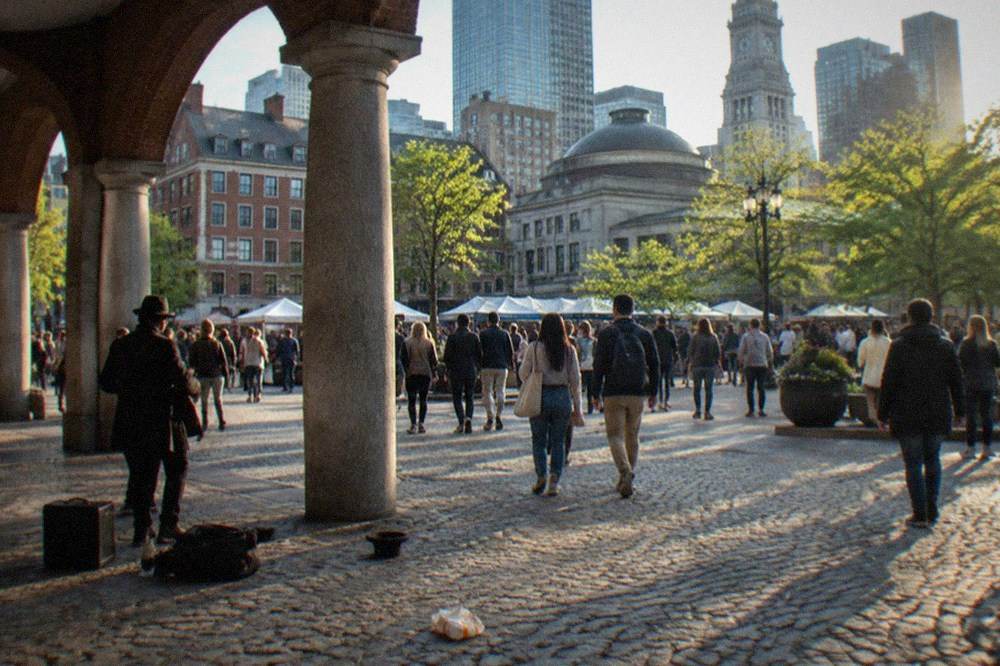
The plaza itself matters to the experience. On a pleasant day it fills with street performers, and the crowd density between the buildings can be the densest pedestrian moment of your Boston trip. If you are timing a food stop around a tour, the plaza is the meeting point for many guided walks, including the history-plus-food combinations that start downtown before heading toward the North End.
A practical note for planning: the surrounding streets are among the oldest in the city, and parking nearby is expensive and scarce. Public transit or a walk from a downtown hotel beats driving. This is one of the few major Boston food destinations where the arriving is genuinely easier than the eating, since the queues at the popular stalls inside Quincy Market move fast but the seating at lunch hour does not.
What Was Faneuil Hall Actually Built For?
Faneuil Hall was built and gifted to the town in 1742 by merchant Peter Faneuil as a combined marketplace and public meeting hall. The ground floor held market stalls; the upper floor held an assembly hall for town meetings. After an expansion in 1805-1806 that widened the building and added a third floor, it became the central stage for Revolutionary-era and abolitionist speech, a role that earned it the nickname "the Cradle of Liberty."
The marketplace function came first, historically. Boston needed a permanent central market, and Faneuil funded the building that gave the town one, along with the meeting space above it that would prove far more famous. The National Park Service, which now maintains the hall as part of Boston National Historical Park, describes it as a marketplace and public meeting space from its origin, and the building is a designated National Historic Landmark. Park rangers run a visitor center inside, and the Great Hall upstairs is open to the public when events are not in session.
The eating, then as now, happened on the ground floor and around the building, not inside the grand hall upstairs. That division still describes the site today: Faneuil Hall is the civic monument, Quincy Market is the food. Visitors who skip the upstairs hall because they came for lunch miss the part of the building that made it nationally significant.
For food travelers the relevance is thematic. The whole idea of Boston as a city organized around public markets, from Faneuil's 1742 marketplace to the Boston Public Market on Hanover Street today, starts in this building. If the market-to-table history interests you more than the revolution history, a walk pairing this site with the North End, an easy ten-minute walk up Hanover or Salem Street, covers the whole span of how this city has fed itself.
Standing inside the hall makes that history tangible, but the connective tissue between this building, the market hall behind it and the food traditions around them is what a guide supplies best. That is exactly the moment a combo walk earns its ticket price.
What Is Quincy Market, And Why Was It Built?
Quincy Market is a granite market hall constructed between 1824 and 1826, opening in 1826 as an expansion of market space for a city that had outgrown Faneuil Hall's ground floor. Named for mayor Josiah Quincy, it was added to the National Register of Historic Places on November 13, 1966. Today its interior is a food hall with dozens of stalls; its exterior colonnades define the look of the whole marketplace.
The historical record of the designation is held by the National Archives catalog entry for Quincy Market, which documents the 1826 opening and the 1966 listing. The building answered a problem any modern food hall visitor will recognize: too many vendors, not enough space. When the stalls at Faneuil Hall overflowed, the city built a dedicated market building behind it, and for decades the area around it filled with pushcarts and wholesale trade.
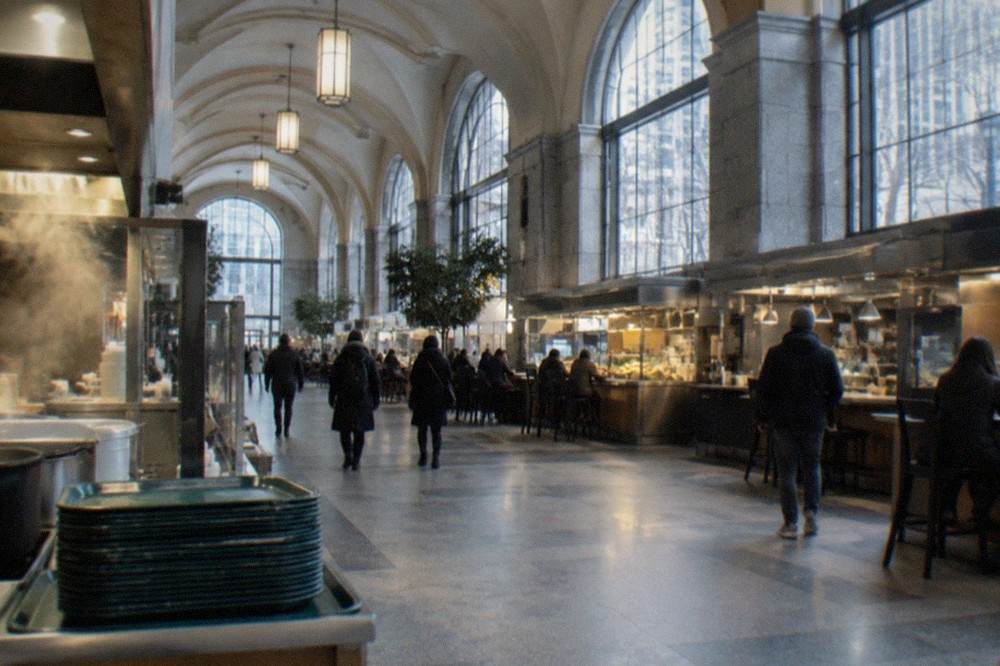
The modern food-hall era began when the complex was redeveloped into the marketplace visitors know now, with Quincy Market's interior converted to a hall of stalls. The central rotunda sits under a large dome, and the stall lineup has included the same anchors for decades: chowder, lobster rolls, pizza, baked goods and the souvenir-worthy takeaway boxes. The building's bones, granite walls, long colonnade, high windows, are what make the eating experience feel different from a mall food court; you are lunching inside a structure that spent its working life as a wholesale market.
That layered history is exactly what a guided food-and-history walk cashes in on. The "Food & History Combo Walk" spends three hours connecting these buildings to the Freedom Trail and the food traditions that grew around them, with a 5.0 rating from 45 reviews and tickets from $135.45. It is a good fit when you want the eating and the explaining in one ticket rather than parsing plaques between bites.
What Can You Actually Eat At Each One?
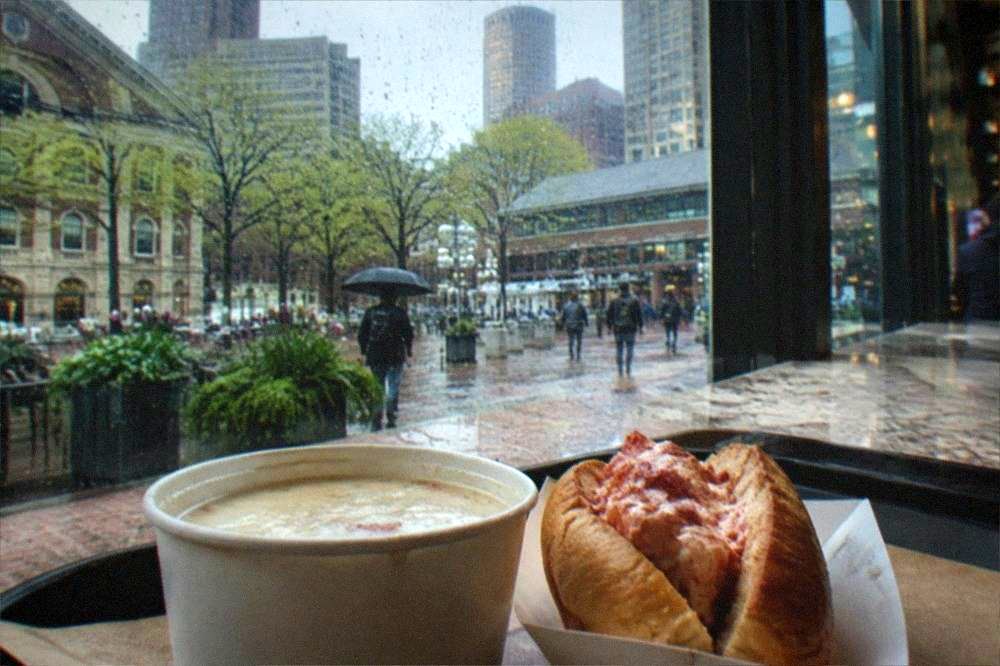
At Faneuil Hall there is little to eat beyond a small retail food presence; the eating happens at Quincy Market, where the food hall's stalls serve chowder, lobster rolls, pizza, sandwiches, baked goods and desserts. Quincy Market is a full lunch destination where a meal for one typically runs $15 to $30 depending on whether you sit down or carry a tray. Faneuil Hall is a twenty-minute history stop, not a meal stop.
The split surprises people who planned a food outing around "Faneuil Hall" as a phrase. You will find some food-adjacent commerce around the hall, but the volume, the variety and the seating are all in the long hall behind it. Inside Quincy Market the stall density is the draw: you can assemble a chowder, a lobster roll and a cannoli from three different counters in under half an hour, though finding a table at noon is the real bottleneck.
| Question | Faneuil Hall | Quincy Market |
|---|---|---|
| Built | 1742, expanded 1805-1806 | 1824-1826, opened 1826 |
| Original job | Marketplace below, town meeting hall above | Dedicated market hall for overflow vendors |
| Role today | Free historic site and visitor center, park-run | Food hall and retail stalls |
| Time to allot | 20-30 minutes | An hour or more with a meal |
| Food on site | Minimal; eating happens next door | Dozens of food stalls, full meal |
| Cost to enter | Free | Free entry; pay per stall |
For a fuller stall-by-stall eating plan through both buildings and the flanking markets, the deeper rundown lives in the Quincy Market and Faneuil Hall food guide, which covers what is worth ordering and what to skip. The short version for the difference question: plan your meal for Quincy Market, and treat Faneuil Hall as the free history appetizer before it.
One planning caution: peak lunch and weekend crowds thin the experience. The stalls move quickly, but table space in the central hall is the scarce resource. Local habit is to grab a tray and head for the edges, where the colonnade seating and the flanking buildings are quieter, or to take food outside to the plaza when the weather cooperates.
Which One Should A Food Tour Route Through?
A food tour routes you through Quincy Market for the tastings and past Faneuil Hall for the history; nearly every downtown-based food tour does both in sequence because the buildings share one plaza. If your itinerary mentions chowder, a lobster roll or a market tasting, that stop is Quincy Market. If it mentions the Revolution and oratory, that stop is Faneuil Hall, and it is usually a brief standing stop rather than a seated one.
This is where the naming confusion costs real money. Travelers book a tour expecting "a food tour of Faneuil Hall" and are sometimes surprised that the hall itself contributes history rather than food, or the reverse, they book a history walk and find lunch built in at the market. Reading a tour's itinerary for the words "Quincy Market" versus "Faneuil Hall" tells you which promise is being made.
The strongest fit for the difference question itself is a combo walk that treats the plaza as one story. The "Food & History Combo Walk," rated 5.0 from 45 reviews, spends three hours on this exact material, from $135.45 per person. For eaters who want a second neighborhood in the same day, the "Dumplings & Dim Sum Walk" in Chinatown, 5.0 from 22 reviews, from $135.45, or the "Seafood & Chowder History Walk," 4.8 from 237 reviews, from $169, both start or end near this downtown cluster and extend the theme.
Can You Do Both Buildings Without A Tour?
Yes, and many people do: Faneuil Hall is free to enter and Quincy Market requires no ticket, only stall spending, so a self-guided visit costs nothing but lunch. The trade-off is interpretation. The buildings' signage covers what they are, but not the connective tissue, how the 1742 marketplace led to the 1826 expansion and how both shaped the eating culture around them, which is the part a guide adds.
Doing it yourself is a reasonable plan on a budget or a tight schedule. Enter Faneuil Hall, take the stairs to the Great Hall if it is open, then walk the plaza and eat your way down Quincy Market's central aisle. A reasonable self-paced visit runs about an hour and a half including eating time. The park's visitor materials and the stall counters themselves carry most of what you need for a casual stop.
The case for the guided version is efficiency of context. A three-hour walk with a guide folds this plaza into the Freedom Trail and the North End in one motion, and the ratings on those walks are strong precisely because the story is the product. For a one-visit trip, a tour turns two buildings you would otherwise photograph into a narrative about how Boston fed itself across its whole history, which is a difference you can feel in what you notice afterward.
Either way, treat the two buildings as one stop with two halves. The mistake is not mixing them up in conversation, which even locals do, but skipping one because you assumed you had already seen it. The guide to the city's food history and culture goes deeper on the market tradition if the self-guided route leaves you curious.
And if one guided bookend is all your day has room for, make it a theme you cannot reproduce alone: the working waterfront story behind the chowder and the lobster roll, tasted rather than told. The "Seafood & Chowder History Walk" described above is that bookend.
How Do The Two Buildings Fit A Day Of Eating In Boston?
Faneuil Hall and Quincy Market work best as the midday anchor of a downtown eating day: the market hall for lunch, the historic hall before or after, then a ten-minute walk up to the North End for pastries, or a short transfer to Chinatown or the Seaport for a second food neighborhood. Two to three hours covers the plaza thoroughly. Adding one guided walk converts the whole day into a structured tasting route.
The geography favors this. The North End begins where the marketplace's crowds thin, and Hanover Street's bakery rivalry is close enough that a cannoli after a chowder lunch is a normal Boston afternoon. Going the other direction, Chinatown sits south of the Common, and the Seaport's seafood cluster sits on the waterfront beyond the Financial District. None of these moves requires a car, which matters because downtown parking around the plaza is the most expensive in the city.
Weekends change the math a little. The plaza's street performers and the market's midday rush land at the same hour, so the same itinerary that feels relaxed on a Tuesday morning feels packed on a Saturday. If your visit falls on a weekend, go early, do Faneuil Hall before the tour groups arrive, and hold the market lunch for the off-peak edge of the lunch hour.
The guided version of that day exists as a product. The combo walks that start at the marketplace and finish in the North End are the classic itinerary, and the trio below covers the three strongest downtown-anchored options on this site: the history walk built around this exact plaza, a Chinatown walk for the second neighborhood, and a seafood walk for the chowder-and-lobster-roll theme that Quincy Market's stalls only sample.
Ordering also matters less than people fear. Faneuil Hall closes in the early evening, but Quincy Market's stalls thin after the lunch rush and the neighborhood walks pick up the evening. If you have only one afternoon, take the market at noon, the hall at one, and the North End by two. If you have a full day, start with a morning walk in Salem or Cambridge and work back toward the plaza for a late lunch, which is the sequence the longer guided routes use to beat the crowds.
Common Questions About Quincy Market vs. Faneuil Hall
Quincy Market vs. Faneuil Hall: What's the Difference?
Faneuil Hall, built in 1742, is a public meeting hall and marketplace, now a free historic site and part of Boston National Historical Park. Quincy Market, built 1824-1826, is the long granite food hall behind it, now full of food stalls. The first is a history stop, the second is where you eat.
Are Quincy Market and Faneuil Hall the same building?
No. They are two separate buildings, generations apart in age, facing each other across a shared cobblestone plaza. The complex as a whole is often called Faneuil Hall Marketplace, which is why the names blur in everyday use, but the hall and the market are distinct structures with distinct histories.
Which one has the food stalls?
Quincy Market. Its interior is a food hall with dozens of stalls serving chowder, lobster rolls, pizza and desserts around a central rotunda. Faneuil Hall has a visitor center and the Great Hall upstairs, and only minimal food retail of its own.
How much time do I need for both?
About an hour and a half at a relaxed pace: 20 to 30 minutes inside Faneuil Hall and the rest crossing the plaza and eating at Quincy Market. Add an hour if you want a full lunch with a table during the midday rush, when seating in the central hall gets tight.
Is there an entry fee for either building?
No. Faneuil Hall is free and Quincy Market has no gate or ticket; you pay only for the food you buy from stalls. A combo guided walk through the area runs from $135.45 per person and adds a guide, tastings and the Freedom Trail context.
Which guided food tour covers both buildings?
The Food & History Combo Walk is built for exactly this: a 3-hour guided walk, rated 5.0 from 45 reviews, that links Faneuil Hall, Quincy Market and the Freedom Trail with tastings along the way. It is the natural pick when the naming difference itself is what you want explained on site.
For planning beyond the plaza, Boston Food Tours breaks down every neighborhood walk in the city, from the North End bakery circuit to the Chinatown dim sum routes, with verified prices and ratings for each one.